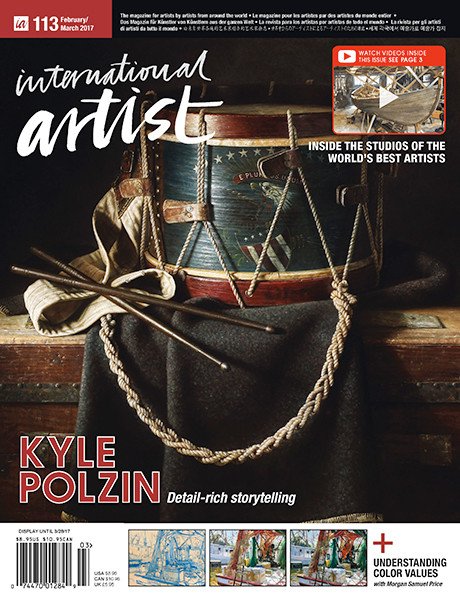
During a 35-year period, Seattle-based gallery A.J. Kollar Fine Paintings acquired works by Charles M. Russell (1864-1926) for a prominent client who was interested in Russell’s authentic depictions of the West. After many years enjoying the works, the collector is now parting with the pieces, which will be featured in a show starting January 15.
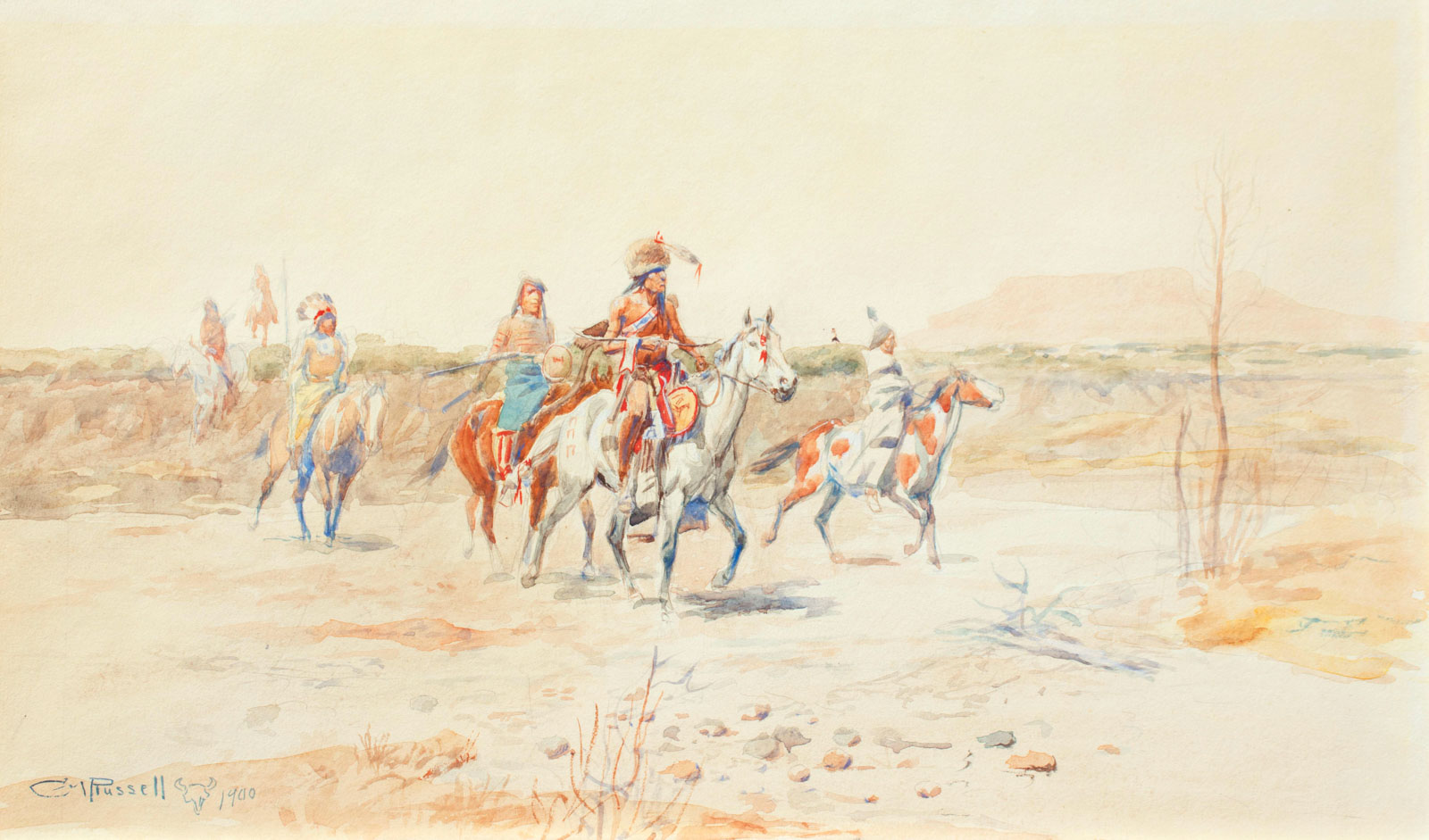 Charles M. Russell (1864-1926), Scouting Party, 1900. Watercolor with China White, 12 x 19 ½ in., signed lower left with buffalo skull: ‘CM Russell’.
“We started this collection more than 35 years ago, and as each piece came in it was amazing to see again and again how good of a draughtsperson Russell was,” gallery owner Allan Kollar says. “The collection is made up of pen-and-ink drawings, some with watercolor, and the detail he was able to capture is incredible. He was an insightful and perceptive artist.”
Russell’s works, even simple drawings and illustrated letters, are collected at very high levels due to the artist’s place within the canon of Western art, where he’s paired alongside many of the greats, including Frederic Remington. A common refrain among Western collectors is “Russell and Remington,” which is shorthand for Western art’s foundational history.
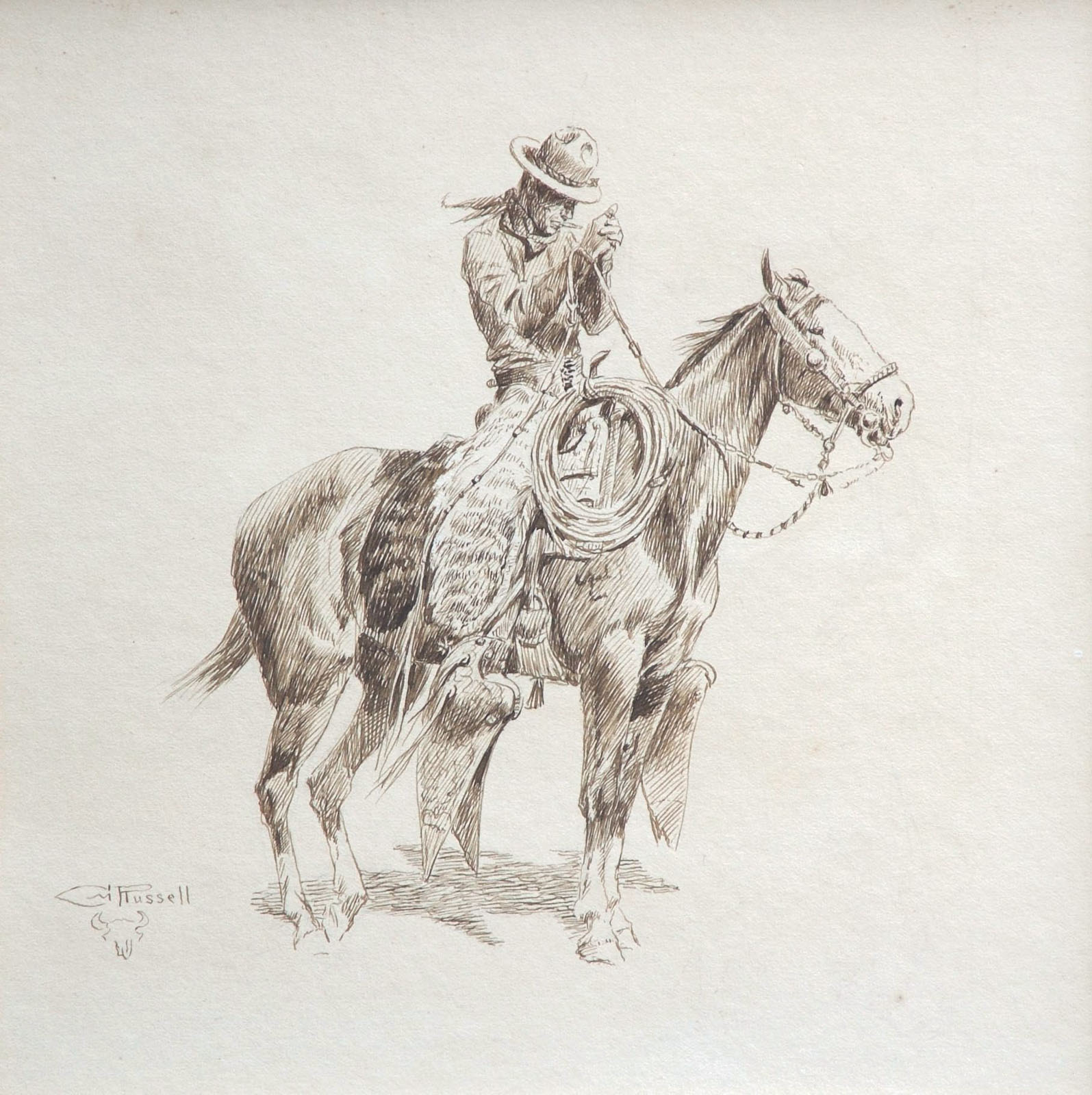 Charles M. Russell (1864-1926), Lazy E.L. Cowboy, ca. 1910. Sepia ink on paper, 10 x 10 in., signed lower left with monogram buffalo skull: ‘C.M. Russell’.
“What made Russell great was he was so interested in history and he used that to record the myth of the West,” Kollar says. “You can see that in his works about the [Native American] people who lived in the territories Russell was familiar with. He used to get in trouble with some of the ranchers because he was showing that the land they were on was stolen. He just had a way of showing the West as it was.”
The collection consists of 17 works that include full watercolor pieces, pen-and-ink drawings (some with watercolor) and also illustrated letters, which Russell was fond of sending to friends and acquaintances. One of the more complete works is the 1900 watercolor Scouting Party, a 20-inch-wide work on paper that shows six Native American riders on horses. Russell focuses on the center of the picture where the main figure is shown with detailed accoutrements, including a war shield, a beaded bag around his torso and an elaborate fur hat with a feather.
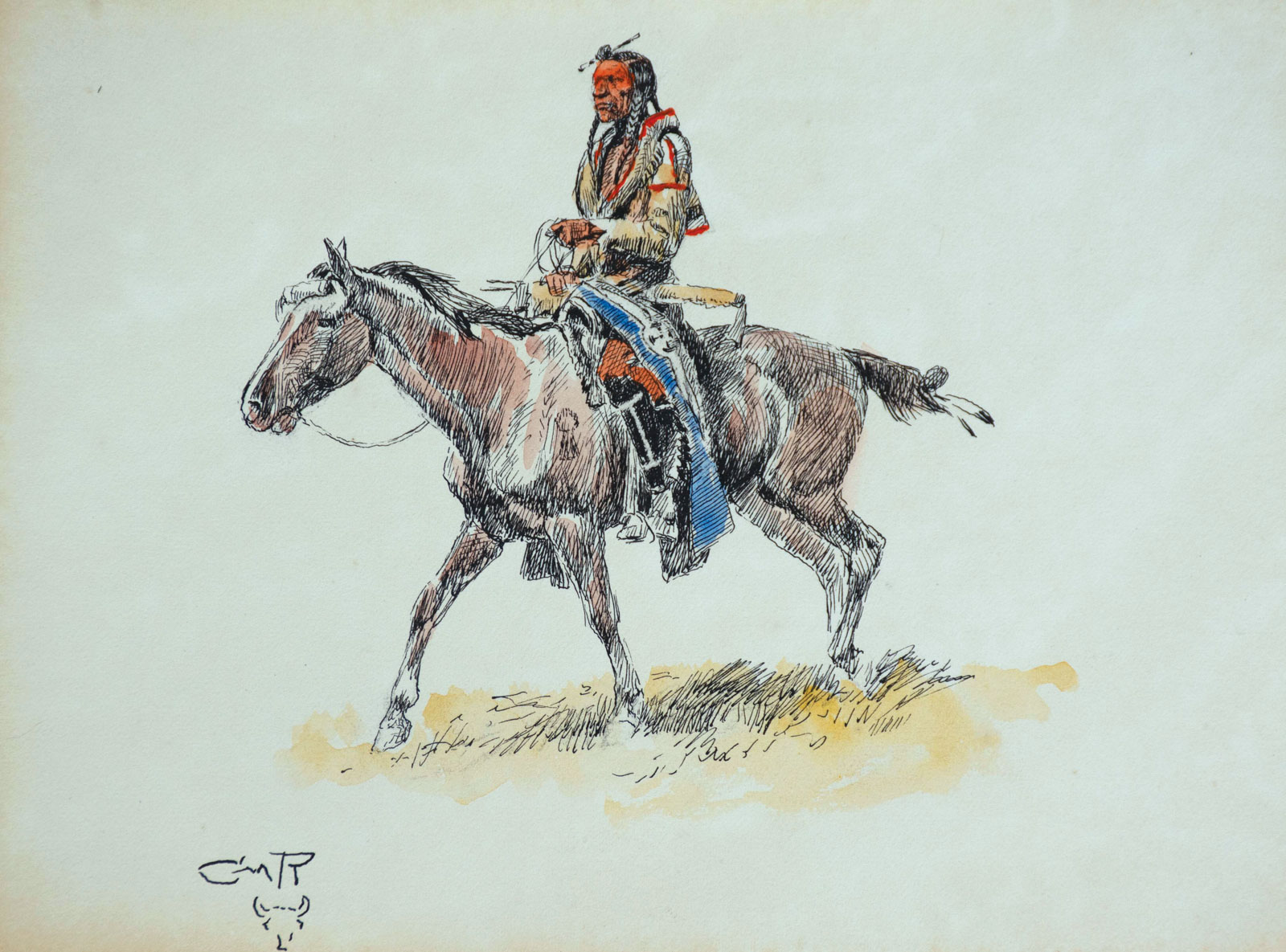 Charles M. Russell (1864-1926), Mounted Indian. Watercolor, pen and ink, 63/8 x 8½ in., monogrammed in lower left with buffalo skull.
In Mounted Police Patrol Captures American Whiskey Runners, Russell’s drawing ability is on full display as short pen marks create a story filled with tension and drama as a pair of mounted officers hold two smugglers in custody. The work also shows Russell’s horse subjects, which he was an expert at drawing and painting—Russell himself was a cowboy and an expert horseman.
In Cowboy Initiating Tenderfoot, Russell draws a subject that appeared in a work about four years earlier—the young and inexperienced city slicker visiting the Old West. The cowboy casually takes aim at the boy’s feet and fires off a round. The oil that would inspire the drawing, simply called The Tenderfoot, is now in the collection at the Sid Richardson Museum in Fort Worth, Texas. Russell used “tenderfoot” in several titles, many of them at the tenderfoot’s expense, who was often on the receiving end of a cowboy prank, whether it was a smoking .45-caliber revolver or a bucking horse.
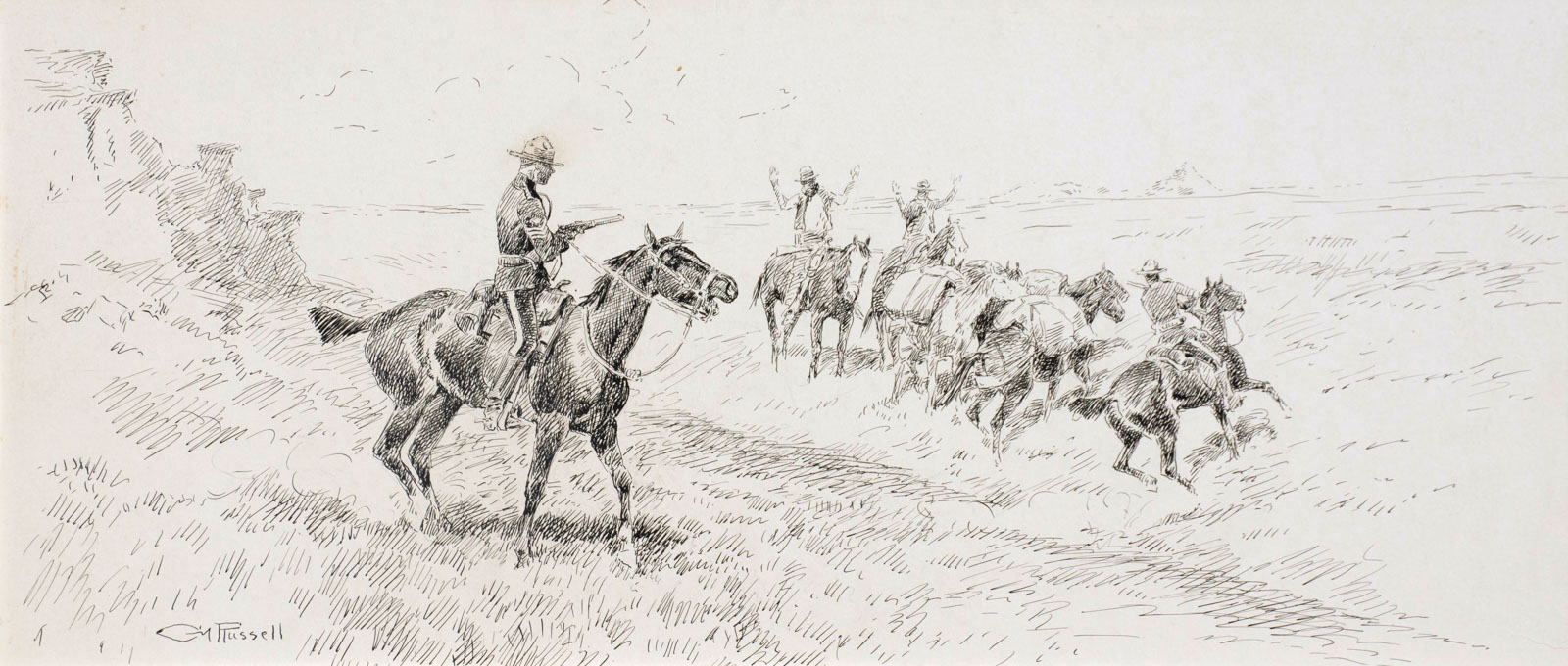 Charles M. Russell (1864-1926), Mounted Police Patrol Captures American Whiskey Runners, ca. 1920. Pen and ink, 9¾ x 19¾ in., signed lower left: ‘C M Russell’.
“This is a special grouping of Russell works,” Kollar says. “We’re excited to see them again and to offer them to new collectors.”
Powered by Froala Editor